
Introduction
Winston Churchill once said, “To improve is to change; to be perfect is to change often.” Change is quite important. We as humans have felt change several times in our lives and careers. And each time a change happens we see a new development in us. Such is the beauty of change. As important as is change the process of change is equally difficult.
Change is also crucial for the companies that we are a part of. These organisations go through phases of changes for better structure and better opportunities. To successfully plan, adapt and move ahead with change, management is important. Leaders and managers are the people who help employees and the organisation to successfully adapt and implement change. For a student of leadership and for a leader of an organisation currently going through change, it is crucial to understand this process of change management.
In this blog, we will discuss in detail every aspect of change management, that will help students of leadership and management as well as the leaders who are currently responsible for change management at their organisations. Let us begin.
What is Change Management?
The process through which a company brings a change in its systems is known as Change Management. The process is structured and supports employees to engage and adapt to change.
Change Management can also be called a multi-step process that ensures the successful execution of the desired outcome.
Why Is Change Management Important?
Change Management is important for organisations for small and large-scale changes. Let us see some reasons why it is important:
- Change Management planning ensures a smoother transition during change.
- Without a decisive plan for change – monitoring, implementing, and reporting of the change tend to fail.
- Change Management allows better control of the plan and investment made for the plan.
- The ability to manage change determines success in new processes.
- Change Management deals with the most valuable resource of the organisation which is humans. So, it is an indication of the strength of the leadership of the organisation.
Change Management Strategies to Manage Change Effectively.
Organisations get tremendous impacts due to change. The volume of human resources involved in the process affects the outcome of the change. This tells us that organisations, their human resources, and change are intricately connected. That is why a strategy for change management is important.
Furthermore, change management requires explicit efforts which are proportional to the involvement of teams, planning, and speed of execution.
1. Detailed Outline of a Plan
With the end goal in mind, prepare a plan to introduce the change to the employees. The plan should have a timeline of the proposed change, metrics for success and answers to possible questions.
Under good leadership, the team would prepare itself for the upcoming change.
2. Communicating and Educating the Plan of Action.
A clear concise communication of goals and desired outputs helps employees understand change. The employees can see the logic for change.
This strategy requires effective communicators and leaders who can convey a plan of action. They need to spend time and effort for the least resistance.
3. Facilitating Change with Support.
Changes are often perceived with the notion of loss. An effective change management strategy executed by a leader would help employees to see beyond such notions. A good leader would work towards supporting his team through open communication and guidance.
Change Management efforts are relative to the volume of people involved. Hence continuous guidance and support of good leaders would facilitate change management.
4. Involving Teams Through Participation.
The management could involve teams and take their opinions into account. Participation will decrease resistance and might offer valuable insight.
Without involving teams, the employees would be poorly informed. An uninformed team might not be proactive for change thus failing management of change.
5. Training the employees
Changes often involve modern technologies or new systems. A uniformed team might resist change due to a lack of skill so a good leader would offer training sessions. Good leadership can recognise the current level of skill within the organisation and facilitate change management.
6. Observe and Manage
Observe the ongoing plan keenly. Check if the metrics for success are being met. Look for possible errors and solve them. Manage resistance with effective communication, negotiation, or training.
7. Show Good Leadership
A change could be tough. Lead the employees with guidance, effective communication, and support. Exhibit strong leadership and drive the team to the end goal. The employees must trust their leader to help them during the toughest of changes.
Change Management Process: The Steps
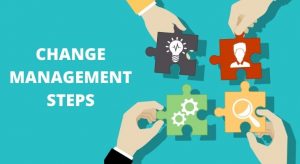
There are 11 steps to manage change.
Before making substantial changes, define the steps to manage change. Understand change management principles for a successful process.
The process may vary based on your organisation and goals.
Step 1: Identify what needs to change.
Look for important things to change in your company. Decide if the changes are worth the time and effort. Consider if the changes will bring benefits or a return on investment. Goals can be achieved under leadership who can focus on culture, specific problems, communication, or training.
Step 2: Prepare everyone for the change.
Involve people in the change process to get them excited. Leaders must understand and communicate the vision for change.
Step 3: Create a vision statement.
Craft a statement that shows the future after the changes. This inspires everyone and helps them understand the goal. The vision statement needs to be impactfully presented.
Step 4: Understand how the change will affect the organisation.
Communicate with employees about why the change is necessary. Work together with your employees, communicate effectively, and stay united throughout the change process. Explain the reasons for the change and what you expect. Demonstrate excellent leadership communication for the desired outcome.
Step 5: Present the changes to stakeholders and get their support.
Involve stakeholders and every necessary party in the plan. Gain their support. Their backing is crucial for the success of your change initiatives. Tailor your goals and presentation to their interests while staying true to your intended changes.
Step 6: Identify people who will drive the changes.
Choose trustworthy people who will positively contribute. Identify reliable individuals within your organisation who can drive the changes. Involve only those people who contribute and understand the transition. Be mindful of the number of change agents to avoid communication issues.
Step 7: Identify and remove obstacles.
Finding the possible threats that might hinder change is essential. Identify obstacles that may hinder progress and work on eliminating them. Assign tasks to the change proponents to speed up and streamline the process. Ensure a smooth path towards achieving your goals.
Step 8: Set goals for the change.
When setting goals for your organisation, think strategically. Make them specific, measurable, attainable, relevant, and timely (SMART goals). SMART goals help you achieve your vision by creating clear and measurable targets. Find areas for improvement by evaluating different systems.
Step 9: Implement the change plan.
Now it’s time to put your plan into action. Focus on executing the plan and being accountable for its success. To make things easier, break down the process into manageable phases. Simplifying the process helps you communicate your ideas clearly and improves your chances of success.
Step 10: Incorporate changes into training and culture.
Train employees, coach change agents, and communicate effectively. Seek sponsorships for resources and manage resistance.
Step 11: Analyse the results and report.
Evaluate the process and make improvements for future changes. Change management is an ongoing process for organisational growth.
Change Management Models: Different Models That Can Be Used to Manage Change Effectively.

Change is a crucial but challenging aspect of business growth. An organisation doesn’t need to adopt a “change is irrelevant” mindset to drive change in a growing business. Change management models act as way finders to navigate difficult transitions and guide you and your team toward adopting new processes and maximising ROI for business process changes.
The best change management models include:
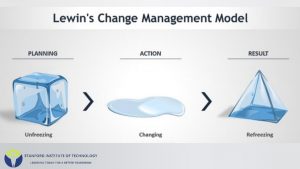
1. Lewin’s Change Management Model:
This three-stage model breaks down big changes into more manageable chunks—unfreezing the current process, making changes, and refreezing the new status quo.
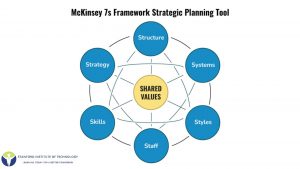
2. McKinsey 7-S Model:
This model examines seven elements (strategy, structure, systems, shared values, style, staff, and skills) and their interplay to identify weaknesses and maintain balance during organisational changes.
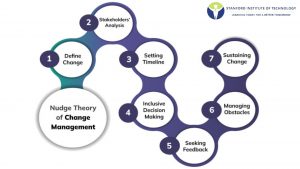
3. Nudge Theory:
This approach suggests using subtle, indirect suggestions backed by evidence to nudge employees towards desired changes, making them feel involved in the decision-making process.
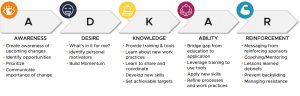
4. The ADKAR Change Management Model:
Focusing on people, this model emphasises awareness, desire, knowledge, ability, and reinforcement as goals to be achieved during change implementation.
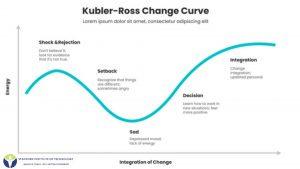
5. Kübler-Ross Change Curve:
Based on the five stages of grief, this model acknowledges the emotional reactions to change—denial, anger, bargaining, depression, and acceptance—and emphasises communication and empathy.
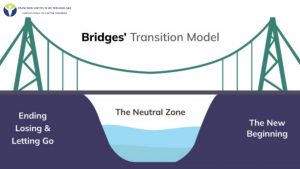
6. Bridges’ Transition Model:
This model focuses on the emotional reactions during a transition, with stages including ending, losing, and letting go; the neutral zone; and the new beginning.
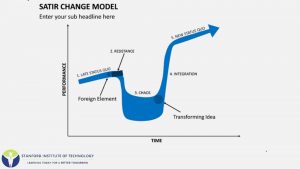
7. Satir Change Model:
Tracking employee performance through late status quo, resistance, chaos, integration, and new status quo stages, this model aims to address resistance and confusion to avoid abandoned changes.
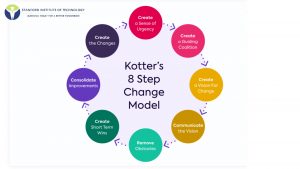
8. Kotter’s 8-Step Theory:
Divided into eight stages, this top-down model creates a sense of urgency, builds change teams, communicates the vision, and removes barriers to change, among other steps.
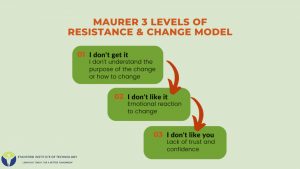
9. Maurer 3 Levels of Resistance and Change Model:
This model addresses the three critical levels of resistance—lack of understanding, negative emotional reactions, and lack of trust—and highlights the importance of information, emotional preparedness, and trust-building.
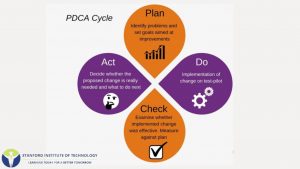
10. Deming Cycle (PDCA):
Also known as the Plan-Do-Check-Act cycle, this framework focuses on process improvement and involves planning, implementing changes, checking progress, and acting based on feedback.
Each of these models offers effective approaches to change management. It’s important to choose the model(s) that best suit your specific situation, whether it’s a large-scale organisational change or a smaller, department-specific change. Remember, you can also combine multiple models to enhance your change management strategy. It is also noteworthy that each model demands excellent leadership to run successfully.
Change management techniques: Discuss different techniques that can be used to manage change effectively.
Use Existing Change Management Models:
Don’t start from scratch when developing strategies for managing organisational change. Many existing methods can be adapted to suit your needs. Good leaders should learn new skills and provide training on change management strategies to all employees. This promotes a positive shift in an organisation.
Establish a Change Advisory Board (CAB):
Form a CAB to assess and authorise each step of a change. The CAB should be led by someone familiar with change management strategies, and its members should represent all groups affected by the change. They act as a bridge between their teams and the CAB, ensuring technical considerations are addressed and all affected teams are represented.
Convey Change Every Information:
Open communication is vital for successful change management. Early and clear communication helps gain stakeholder buy-in and encourages adoption. Share the vision for significant changes in a way that non-technical stakeholders can understand. Clearly outline the path ahead and maintain ongoing communication to reassure stakeholders.
Manage And Prioritise Change Requests:
Document and assess change requests to determine their worth and relevance. Prioritise change requests to focus on the most beneficial ones. Keep a record of all change initiatives, even if they are rejected. Consider using software-based tools to manage change effectively.
Provide Training to All Change Agents:
Change agents, or change champions, advocate for change within the organisation. They actively seek new ways of doing things alongside their regular responsibilities. Establish a network of change agents throughout the organisation to promote a change-positive culture and engage teams that may be less involved.
Resolve Change-Related Risks and Issues:
Identify risks and issues as early as possible to mitigate their impact. Openness and honesty are crucial, as those opposing the change may use issues against you. Proactively plan and have contingency measures in place. Having a clear rollback plan or alternative path helps manage larger risks. Use emotional intelligence and critical thinking for better resolution.
Change management tools: Discuss different tools that can be used to manage change effectively.
Wrike
Price: Free plan available, paid plans start at $9.80/user/month.
Best For: Team collaboration solutions.
About: Wrike is a powerful change management tool that is trusted by over 20,000 organisations worldwide. It offers features like lists, boards and tables, and Gantt charts to organise change management projects.
Wrike’s customizable interface allows teams to track training programs and engagement. All the tracking can be done under a single digital hub for information. With over 400 integrations, employees can make systematic adjustments within the platform. These integrations are timely updated providing the latest technologies to its users.
Wrike saves time and effort. It is easy to learn, with an intuitive interface. It comes with a dedicated help centre for training and support.
WalkMe
Price: Free demo, $2,000 to $3,000 annually
Best For: Managing customer and employee change
About: WalkMe is a software platform that requires no coding. It provides guidance tools to prevent mistakes and encourage goal completion. It offers custom desktop notifications and Help Desk access. WalkMe provides insights into digital behaviour. User issues can be easily detected and resolved using WalkMe.
WalkMe supports popular software platforms like Salesforce, Workday, Jira, NetSuite, and TalentSoft. So, if you are using these apps already, WalkMe would be highly effective for you.
WalkMe’s software uses artificial intelligence (AI) with machine learning (ML). It studies usage patterns and provides quick support for potential issues. WalkMe is a cost and time-efficient tool.
ManageEngine ServiceDesk Plus
Price: Free demo available. Customised price upon request.
Best For: Visualizing change management with the visual workflow builder.
About: ServiceDesk Plus is an IT Service Management (ITSM) suite with built-in IT Asset Management (ITAM) and Configuration Management Database (CMDB). It helps calculate risks and plan change implementation.
The tool’s IT change management module helps teams to implement changes with minimal risk. The module designs change processes on a visual workflow designer.
It offers custom change roles, types, statuses, and templates. The suite comes with a Change Advisory Board (CAB) feature. Users can track changes resulting from incidents and problems which helps them to communicate planned downtime to end-users. Users can create automated workflows and notifications for stakeholders.
Whatfix
Price: Free trial. Pricing upon request.
Best For: Adopting new software in an organisation.
About: Whatfix is a change management tool that helps employees onboard to new software easily. It allows the design of real-time interactive guides without coding. The tool provides contextual widgets, such as self-help, task list, and smart tips overlays, as well as in-app training in various formats.
Whatfix is also accessible to differently abled people also. It complies with accessibility standards with section 508 of the U.S. Rehabilitation Act. It can be adapted for other use cases as well. Pricing is customizable for Whatfix.
Viima
Price: Free for up to 50 users. Then starts from $3/user/month
Best For: Small companies
About: Viima is a collaboration-first change management platform designed to gather ideas from employees, customers, and other stakeholders. It facilitates idea refinement and development through team collaboration. It offers an analysis of the innovation process to identify and eliminate bottlenecks.
Viima is an excellent choice for small businesses due to its low cost and minimal barriers to entry. It provides many services for free, catering to a limited number of users, and offers Apple and Android apps to help scattered teams stay connected.
While the reporting visualisation and exportation of data could be improved for better functionality. Integrations with project management tools could enhance its capabilities and make it a more well-rounded application.
SysAid
Price: 30-day free trial. $1,211 for 500 assets.
Best For: Change management based on ITIL.
About: SysAid is an ITSM platform that facilitates change management based on IT Infrastructure Library (ITIL) best practices. It provides pre-configured workflow templates and allows users to create custom change process templates. The ITSM offers non-repetitive automated solutions to users.
The tool includes multi-level authorization, risk assessment, and reporting tools for tracking the impact of changes. Users can evaluate potential risks, ensure approved changes adhere to strategies and policies, and involve stakeholders outside the IT department.
eSM Software
Price: Free Version available, Subscription starts from $800/month for unlimited users.
Best: Nonprofits (special pricing)
About: eSM Software provides a comprehensive suite of offerings, including Balanced Scorecard Software for top-down strategy, Employee Review Software, and Strategy Consulting Services. It takes a big-picture approach to change management by breaking down information into goals, interconnections, initiatives, KPIs, and much more.
eSM Software’s focus on interconnectivity and unified vision makes it suitable for large-scale corporations. The software offers limited touchpoints with staff across departments. It also caters to smaller teams working online or remotely, ensuring alignment towards common goals.
Although additional financial planning options, such as profit and loss statements, would be beneficial, eSM Software’s emphasis on strategy and connectivity remains its strength. However, compared to other options available, its paid plan is relatively expensive.
Engage Your Team
Price: From $35/user/month
Best For: HR management
About: Engage Your Team is an HR management tool. It focuses on supporting change within HR processes. The tool offers priority action plans based on survey data. It helps identify areas that need improvement such as cross-functional collaboration, learning and development, IT management, and much more.
Engage Your Team provides customizable surveys and reports. These tools assess leadership profiles, validate employee strengths and weaknesses, and promote engagement. The software’s user-friendly interface and flexibility make it easy for HR teams to manage and analyse employee data.
However, its limited integration with other HR systems might be a drawback for larger organisations.
Howspace
Price: From $7/user/month
Best: Collaboration and virtual workshops
About: Howspace is a digital facilitation platform that enables collaboration and virtual workshops. It is an ideal tool for managing change in remote and hybrid work environments. It offers features like interactive workspaces, real-time collaboration tools, and data-driven insights to support teams in driving change.
Howspace provides a variety of templates for different change management use cases, such as strategy execution, innovation, and project management. Its user-friendly interface and customizable branding options make it a popular choice for organisations looking to create engaging and interactive change management experiences.
While Howspace offers a comprehensive set of features some users may find the learning curve slightly steep initially. However, with practice and guidance, teams can fully leverage the tool’s capabilities to facilitate effective change management.
Change Management Plan: Outline of Key Components of a Change Management Plan.
Change happens in every organisation. It could be due to new leadership, market changes, or technology advancements. Managing change can be challenging. Change management involves planning, implementing, and monitoring changes to ensure they succeed and benefit the organisation. In this blog post, we’ll discuss five key principles of change management.
First, there’s planning. Planning helps identify goals, needed resources, and potential challenges. It includes defining the change’s scope, creating a timeline, and developing a project plan.
Second, communication is crucial. Effective communication builds trust, promotes buy-in, and ensures everyone is informed.
Third, stakeholder engagement is important. It involves all affected individuals and groups. Engaging stakeholders build support and active involvement.
Fourth, there’s training and development. This principle helps employees and stakeholders understand the change, acquire new skills, and adapt to new ways of working.
Lastly, monitoring and evaluation play a vital role. They help identify issues, evaluate the change’s success, and make necessary adjustments.
Change management best practices: Discuss best practices for managing change effectively.
Here are the top 11 best practices for managing change in simple language:
- The change management plan should have excellent leadership.
- Understand how much risk your organisation can handle, and plan accordingly.
- Continually assess risks using data to adjust your change management approach.
- Keep change management as simple as possible.
- Think differently about the traditional way of handling change advisory boards (CAB).
- Use tools to automate and improve your processes.
- Release changes in smaller steps, gradually, to ensure everything goes smoothly.
- Consider guidelines that are not strict rules.
- Give collaboration and teamwork a high priority.
- Take advantage of resilient engineering techniques.
- Choose tools that your development teams are familiar with and enjoy using.
Let us understand this knowledge with a Case Study of Coca-Cola.
(Case Study) Change Management Plan: Coca-Cola

One organisation that has effectively utilised change management is the Coca-Cola Company. As a renowned retailer, marketer and manufacturer of non-alcoholic beverages, Coca-Cola operates in over 200 countries and offers a wide range of brands.
Throughout its history, the company has undergone numerous changes to adapt to consumer expectations and changing markets. During World War II, Coca-Cola managed to maintain its position while also entering new markets and niches. By providing free drinks to soldiers, the company positioned itself as a symbol of patriotism, boosting sales and expanding its reach. Similarly, the company responded to changing consumer preferences by developing new products like Diet Coke and Coca-Cola Zero. Coca-Cola has also adjusted its advertising strategy to target specific consumer groups in different regions. The company broadened its product lines and focused on health drinks such as juices and energy drinks.
By utilising change management principles and strategies, Coca-Cola has successfully navigated the changing markets and maintained its position as one of the world’s most recognized brands.
The change management within the company has recently been focused on employee engagement, which aims to align employees with the company’s values and operational excellence. Coca-Cola wants to create a sense of brand ownership within its employees and boost ideal behaviours by integrating internal branding programs and communication initiatives. This approach enhances operational efficiency and ensures that employees across all segments of the business are aligned with organisational objectives. Coca-Cola understands that employee engagement is essential for achieving a committed and high-performing workforce. To achieve this, Coca-Cola conducts employee engagement surveys, listens to feedback, and takes action to address areas of improvement.
Conclusion
With this guide, we hope you understand the need, scope, and steps to Change Management. The models and strategies are pillars of any change management plan. The software tools will not only help the organisation but every employee using it. We also want to highlight the importance of good leadership throughout the change management process. A good leader with his communication skills, learning skills and management skills navigates his team and the whole organisation towards success. It is essential for organisations to recruit such leaders who possess leadership and management skills. It is also essential for the employees to learn these skills so that they can use them when needed.
Are you someone who wants to upskill and be the leader who can manage change management for his organisation?
You can enrol in BSB60420- Advanced Diploma of Leadership and Management. This course covers every skill that leadership requires.